
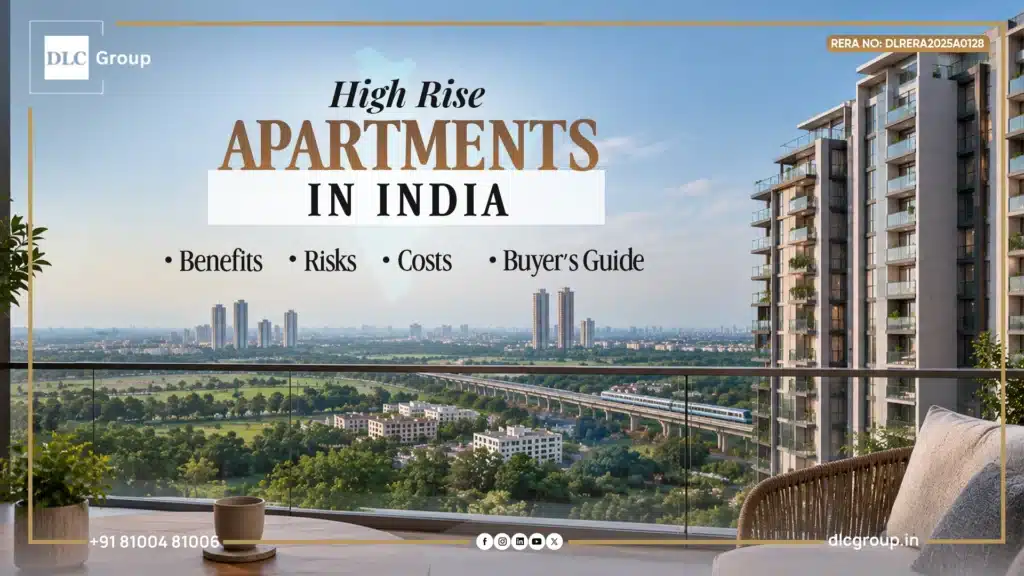
High rise apartments have become an important part of urban housing in India, particularly in growing residential markets such as Gurugram, Noida and Delhi NCR. They offer modern amenities, elevated views, managed security and access to community facilities. However, choosing the right apartment requires more than comparing a tower’s appearance, floor number or advertised amenities.
For homebuyers and investors, understanding high rise apartments means evaluating construction quality, fire safety, lift facilities, maintenance expenses, legal approvals and long-term resale potential. This guide explains the advantages and disadvantages of high-rise living, compares high-rise and low-rise apartments, and outlines the essential checks to complete before booking a flat.
A high-rise apartment is a residential unit within a multi-storey building designed to accommodate multiple households across several floors. In India, everyday property marketing often uses the term for towers with approximately 10 or more floors. However, the National Building Code-related classification uses a height-based benchmark: buildings measuring 15 metres or above are generally treated as high-rise buildings for relevant building and fire-safety purposes.
The applicable requirements depend on the building regulations and local authority rules governing a particular project.
For buyers, the important distinction is between a building’s marketing description and its actual regulatory classification. Before booking a flat, verify the sanctioned building plans, applicable approvals and safety provisions rather than relying solely on the number of floors.
India is home to several premium high-rise residential developments offering luxury living, modern amenities, and attractive locations. Here are 10 notable high-rise apartment projects across major Indian cities.
An ultra-luxury residential development on Golf Course Road, known for its exclusive residences and premium lifestyle amenities.
A premium residential project offering spacious apartments, contemporary architecture, and upscale facilities.
A residential development near Dwarka Expressway, featuring landscaped surroundings and modern apartment living.
A luxury residential project along Dwarka Expressway, designed around contemporary living and modern amenities.
A landmark collection of luxury residential towers offering premium apartments and panoramic city views.
A prestigious high-rise development combining luxury residences with premium hospitality and lifestyle facilities.
An integrated development combining residential spaces with commercial, business, and retail facilities.
A large residential development offering apartment options, landscaped spaces, and lifestyle amenities.
A premium apartment development designed for modern urban living in Hyderabad’s growing western corridor.
A prominent residential skyscraper in the World Towers complex, recognized for its high-rise architecture and luxury residences.
Urban expansion and the growing demand for organised residential communities have increased interest in high-rise housing. These developments can accommodate more homes on limited land while offering shared facilities and professionally managed common areas.
Depending on the project, residents may have access to landscaped gardens, fitness centres, swimming pools, clubhouses, security systems and dedicated parking. Higher floors may also provide broader views and less direct exposure to street-level activity.
However, these benefits are not guaranteed in every development. The actual living experience depends on the building’s design, construction quality, maintenance standards and management.
Buyers should therefore assess the complete residential environment instead of making a decision based only on a project’s advertised lifestyle features.
Upper-floor apartments can offer open views of the surrounding city, landscaped areas or distant natural features. Depending on tower spacing and window placement, they may also receive good natural light and ventilation.
Greater separation from busy roads can reduce some street-level disturbances. Nevertheless, actual noise levels depend on traffic patterns, nearby construction, building insulation and the direction in which the apartment faces.
Many high-rise residential developments include gated entrances, visitor management, CCTV surveillance and security personnel. These arrangements can improve access control and provide residents with a more organised residential environment.
Buyers should confirm how security is managed, whether visitor entry is monitored and what arrangements exist for emergencies.
Clubhouses, gyms, walking paths, children’s play areas and community spaces can make daily life more convenient. Families may value the opportunity to access recreational facilities without travelling outside the residential complex.
Explore Premium Apartment and Luxury Property Options to compare the types of residential opportunities available to buyers looking for premium living experiences.
High-rise buildings allow developers to accommodate multiple residential units within a defined land area. In expanding urban markets, this approach can support planned residential communities with shared infrastructure and facilities.
However, efficient land use does not automatically guarantee good construction, sufficient open space or a comfortable resident experience. These aspects must be evaluated at the individual project level.
Despite their benefits, high rise apartments involve practical considerations that buyers should evaluate carefully.
These disadvantages do not make high-rise housing unsuitable. They highlight why due diligence is essential before making a long-term financial commitment.
The right choice depends on your budget, family requirements, accessibility preferences and expectations from a home.
| Factor | High-rise apartments | Low-rise apartments |
|---|---|---|
| Views | Often broader, particularly on upper floors | Usually more limited by surrounding buildings |
| Lift dependency | Generally high | May be lower or absent |
| Shared amenities | Can include extensive common facilities | Depend on the development |
| Maintenance | May involve more complex building systems | Often simpler, but project-dependent |
| Emergency access | Requires careful evacuation planning | May offer simpler ground-level access |
| Privacy | Can improve on certain upper floors | Depends on layout and neighbouring homes |
| Best suited for | Buyers seeking managed communities and vertical living | Buyers prioritising easier ground access or fewer floors |
There is no universally superior option. A well-maintained low-rise development may suit one household better than a premium tower, while a properly managed high-rise may offer greater convenience to another.
To explore different housing formats, Compare Residential Properties Across Delhi NCR and evaluate location, property type, facilities and budget before narrowing your choices.
The best floor depends on accessibility, views, personal comfort, price and the needs of everyone living in the home.
Before deciding, compare the actual carpet area, apartment orientation, surrounding construction, lift arrangements and total price. Do not pay a premium simply because a unit is on a higher floor.
High-rise apartment safety should be one of the most important parts of the buying process. A building’s height makes its emergency systems, maintenance and management arrangements especially relevant.
Before booking or taking possession, check the following:
For a Gurugram property, buyers should also check the relevant project records through Haryana RERA’s registered-project information where applicable. Registration alone should not be treated as proof that every construction or safety requirement has been satisfied.
The purchase price is only one part of the cost of owning a high-rise flat. Buyers must also understand recurring expenses and any additional charges linked to shared facilities.
Common maintenance-cost components may include:
Not every project charges for these items in the same way. Some costs may be included in a consolidated maintenance bill, while others may be charged separately.
Before booking, request the estimated monthly maintenance amount, payment frequency, included services and applicable additional charges. Also ask how maintenance fees may change over time.
For a clearer understanding of the buying process, Learn What to Check Before Buying a Luxury Apartment before comparing premium residential options.
Legal verification is essential for both completed and under-construction properties. The Real Estate (Regulation and Development) Act, 2016, establishes a framework for project registration, disclosures and buyer protection, subject to its applicable provisions and exemptions.
Before making a booking, review these important details:
Pre-launch and under-construction properties require particular care. Before committing money, Understand Pre-Launch Apartments and Project Verification and confirm which approvals, registrations and disclosures apply to the specific project.
High rise apartments can be considered for investment, but their suitability depends on the location, purchase price, developer execution, rental demand and ongoing ownership costs.
Investors should assess the following factors:
An expensive apartment is not automatically a better investment. Buyers should calculate potential returns using realistic assumptions and account for vacancy, expenses and market uncertainty.
For additional guidance, Evaluate the Risks Before Investing in Residential Property before finalising an investment decision.
Delhi NCR offers different residential choices for buyers seeking high-rise living, including developments in Gurugram, along Dwarka Expressway and in Noida. The right micro-market depends on commuting requirements, budget, infrastructure access and the purpose of the purchase.
Gurugram attracts buyers seeking access to corporate employment centres, organised residential communities and premium housing. Dwarka Expressway is another area where buyers can compare residential developments, but individual projects should be assessed on their own merits rather than assuming that every property will deliver similar benefits.
For example, See a High-Rise Residential Development on Dwarka Expressway to examine a project-specific option in Sector 108, Gurugram.
Buyers exploring other premium locations can Browse Flats for Sale in Gurugram And Explore Luxury High-Rise Living in Sector 113, Gurugram.
You can also Review a Premium Apartment Project in Gurugram when comparing residential layouts, amenities and project documentation.
The objective should be to compare suitable properties using consistent criteria, including location, carpet area, approvals, maintenance obligations and possession status.
Use this checklist before booking a flat:
If you need assistance comparing locations, budgets and project requirements, Get Help Comparing Property Options and Requirements. You can also View Available Property Options from DLC Group and Read More Practical Guides for Property Buyers before making a final decision.
Discuss your location, budget and property requirements with our team.
📞 Call: +91 81004 81006Or email us at Info@dlcgroup.in
A high-rise apartment is a residential unit within a multi-storey building. In Indian building and fire-safety contexts, a height of 15 metres or above is an important high-rise classification benchmark, subject to the applicable regulations.
They can provide safe housing when properly designed, approved, maintained and managed. Buyers should verify applicable fire-safety provisions, emergency exits, evacuation procedures, structural documentation and essential building services.
They can have higher maintenance requirements because lifts, fire-safety systems, security and shared amenities need regular upkeep. Actual charges depend on the project, facilities, management arrangements and services included.
There is no single best floor for everyone. Lower floors may offer easier access, middle floors can provide a practical balance, and upper floors may offer broader views. Accessibility, evacuation, heat exposure and price should guide the decision.
They may suit investors when location, pricing, rental demand, developer quality and ownership expenses align with their financial goals. Appreciation and rental returns are not guaranteed and should be evaluated using realistic market evidence.
Check applicable RERA registration, approved plans, land-title documents, fire-safety arrangements, lift and power backup, carpet area, maintenance costs, agreement terms and possession documentation. Verify project-specific information with the relevant authorities.
They can be suitable if lifts are reliable, backup power is adequate, entrances are accessible and emergency arrangements are effective. Families should assess mobility needs and the practical consequences of a lift outage before choosing a floor.
High rise apartments offer a combination of urban convenience, shared amenities, views and managed residential facilities. However, the right purchase depends on more than a building’s height or luxury features. Safety compliance, legal documentation, maintenance costs, floor selection and long-term demand should all form part of the decision.
For homebuyers and investors in Delhi NCR, a structured comparison of locations and individual projects can help identify a property that fits their needs and financial plans. Conduct independent legal and technical checks, verify current project records and assess affordability before making a commitment.
Real Estate Advisory
